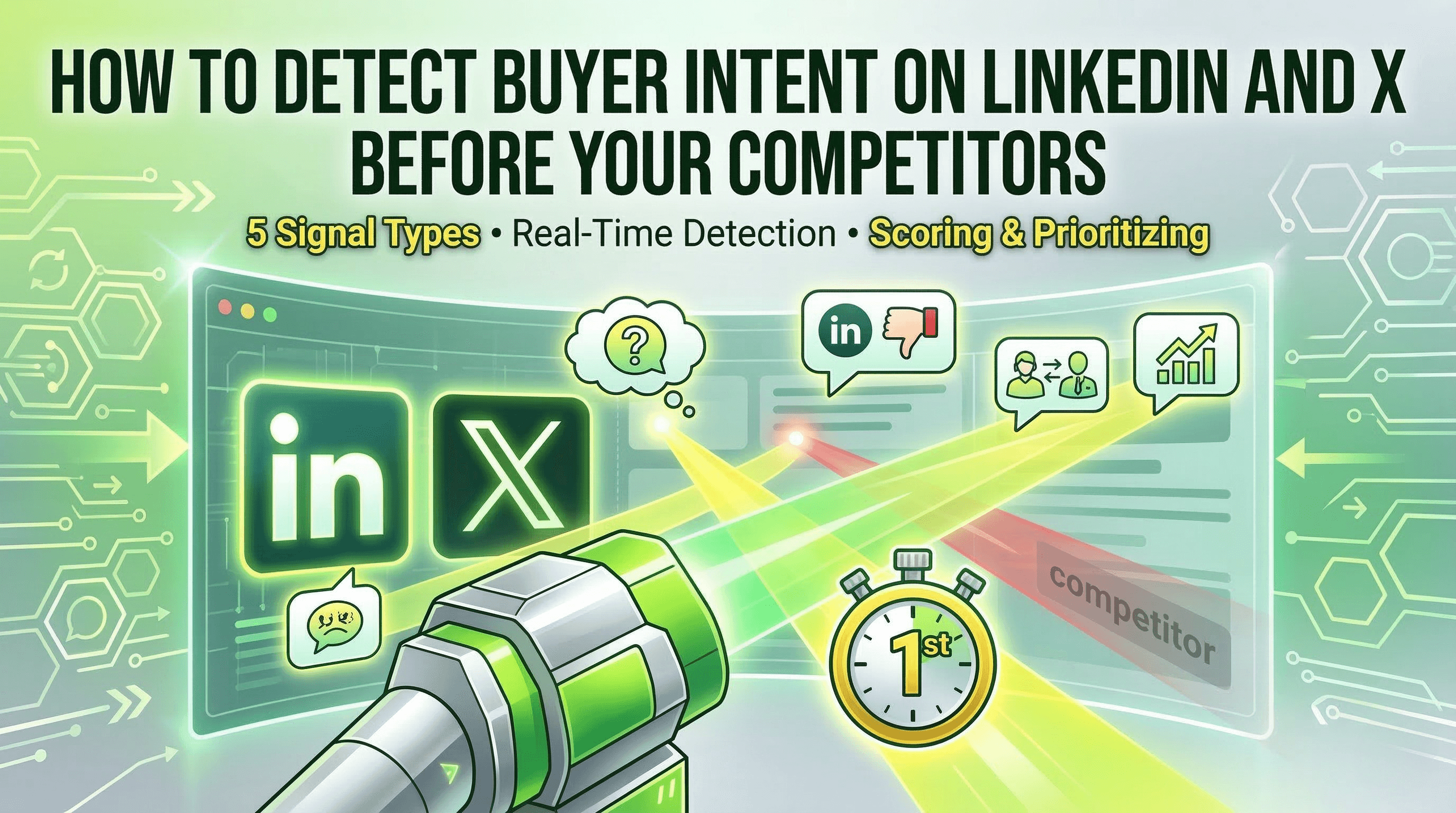
How to Detect Buyer Intent on LinkedIn and X Before Your Competitors
Learn how to detect buyer intent signals on LinkedIn and X (Twitter) before your competitors do. Covers the 5 signal types, real-time detection methods, scoring frameworks, and tools that surface in-market buyers in 2026.
Your next customer just told the internet they need what you sell. They didn't fill out a form. They didn't visit your website. They posted on LinkedIn about a problem your product solves, or they tweeted asking for tool recommendations. And you missed it.
Meanwhile, a competitor saw the signal, replied within an hour, and booked the meeting.
This is the new reality of B2B sales in 2026. The 6sense Buyer Experience Report found that the first vendor to engage wins approximately 80% of deals, and 95% of the time, the winning vendor was already on the buyer's Day One shortlist. Buyer intent signals on LinkedIn and X are the fastest way to detect in-market buyers — and the teams that detect them first win.
This guide breaks down exactly how to detect buyer intent on LinkedIn and X before your competitors, what signals to look for, how to score them, and how to turn detection into booked meetings.
Table of Contents
- What Are Buyer Intent Signals on Social Media?
- Why LinkedIn and X Are the Best Sources for Buyer Intent
- The 5 Types of Buyer Intent Signals to Detect
- How to Detect Buyer Intent on LinkedIn
- How to Detect Buyer Intent on X (Twitter)
- Why Cross-Platform Detection Gives You an Unfair Advantage
- How to Score and Prioritize Buyer Intent Signals
- From Detection to Meeting: The Response Playbook
- Common Detection Mistakes That Cost You Deals
- Key Takeaways
- FAQ
What Are Buyer Intent Signals on Social Media?
Buyer intent signals are observable behaviors that indicate a person or company is moving toward a purchase decision. On social media specifically, these signals show up as posts, comments, engagement patterns, and profile changes that reveal a prospect's current needs, frustrations, and readiness to buy.
The difference between social intent signals and traditional intent data is specificity. Traditional intent data providers like Bombora or G2 tell you "Company X is researching CRM software" based on anonymous web activity. Social intent signals tell you "The VP of Sales at Company X just posted that their current CRM is costing them deals because it can't track multi-threaded conversations." One is a vague directional indicator. The other is a conversation starter.
91% of B2B marketers now use intent data to prioritize accounts, and 98% call it essential for demand generation. But most of that data is anonymous, company-level, and delayed. Social selling signals on LinkedIn and X are individual-level, public, and real-time — which is why teams using social signals achieve 78% higher conversion rates than those relying on static segmentation.
Why LinkedIn and X Are the Best Sources for Buyer Intent
Not all platforms are created equal for detecting buyer intent. LinkedIn and X stand above the rest for B2B signal detection because of who uses them and how.
LinkedIn: Where Buyers Signal Professionally
Over 80% of B2B social media leads originate from LinkedIn. It's where decision-makers announce role changes, discuss strategic initiatives, publish thought leadership about their challenges, and engage with vendor content. 75% of B2B buyers use social media to support purchasing decisions, and LinkedIn is the primary platform for that research.
LinkedIn signals tend to be structured, deliberate, and career-oriented. A post about "rethinking our outbound strategy" is a considered signal — the person thought about it, wrote it, and published it to their professional network. These signals are high-quality but can be subtle. A VP quietly liking three posts about sales automation over two weeks is a signal you'd miss without systematic monitoring.
X (Twitter): Where Buyers Signal Honestly
X is faster, more unfiltered, and more emotionally raw. Buyers say things on X they would never post on LinkedIn. A founder will tweet "our outreach tool is garbage and I've wasted 3 months on it" at 11 PM — that's not a LinkedIn post, but it's a buyer intent signal with a flashing neon sign.
58% of technology buyers in SaaS, fintech, and cybersecurity remain active on X. The platform moves fast, which means signals have a shorter shelf life but higher urgency. A tweet asking "anyone have a good alternative to [competitor]?" is a buying signal that expires in hours, not days.
Reps who read X signals operate in a channel with far less competition than LinkedIn. Most sales teams aren't monitoring X at all, which means the signals are there for the taking.
The Compound Effect
Monitoring one platform gives you a partial picture. Monitoring both gives you a structural advantage. A prospect might post a thoughtful LinkedIn article about outreach challenges on Monday and tweet a frustrated rant about the same problem on Thursday. Together, those signals confirm strong intent. Individually, either might be noise.
The 5 Types of Buyer Intent Signals to Detect
Not all signals carry the same weight. Understanding the five types — and their relative strength — is what separates effective signal-driven outbound from random social listening.
1. Pain Point Signals (Highest Priority)
These are the strongest signals because the prospect is explicitly describing a problem you solve.
- A LinkedIn post about struggling with low reply rates on outbound
- A tweet complaining about their current tool's limitations
- A comment thread describing a broken workflow or failed campaign
- An article published about challenges they're facing in their role
When someone publicly describes the pain your product addresses, they are telling you exactly how to open the conversation. These signals deserve immediate action.
2. Recommendation Signals (High Priority)
The buyer is actively evaluating solutions. They haven't committed yet and they're gathering input.
- "Can anyone recommend a good tool for..." posts on LinkedIn
- "What do you all use for..." tweets
- Poll posts comparing different approaches or vendors
- Questions in LinkedIn groups about solving specific problems
Recommendation signals have a short window. If someone asks their network for tool suggestions, they'll receive 10-20 replies within 24 hours and start evaluating immediately. Responding within the first few hours is critical.
3. Competitor Signals (High Priority)
The prospect is engaging with or mentioning competitors — positively or negatively.
- Liking or commenting on a competitor's product announcement
- Tweeting about switching away from a competitor
- Posting a review (positive or negative) of a competing product
- Following multiple competing vendors within a short period
Negative competitor signals are especially valuable. Someone expressing dissatisfaction with a competing solution is actively open to alternatives right now. Positive competitor signals still matter — they reveal that the prospect is in-market for your category.
4. Career Transition Signals (Medium-High Priority)
Job changes, promotions, and new hires create buying windows. Newly hired executives spend 70% of their budget in the first 100 days, and decision-makers are 62% more likely to respond to outreach after a job change.
- New role announcements on LinkedIn ("Excited to share that I've joined...")
- Updated LinkedIn titles or headlines
- "We're hiring" posts that reveal strategic direction
- Company announcements about new departments or teams
A new Head of Sales at a growing SaaS company is almost certainly evaluating their outreach stack within the first month. That's your window.
5. Contextual Growth Signals (Medium Priority)
These don't confirm individual intent, but they create conditions where purchases become likely.
- Funding announcements — 71% of funded companies finalize vendors within 90 days
- Revenue milestones or growth announcements
- Office expansions or market entry announcements
- Hiring surges in specific departments (posting 5 SDR roles = investing in outbound)
Contextual signals are most powerful when stacked with other signal types. A company that just raised a Series B (contextual) whose CEO is tweeting about needing better pipeline tools (pain point) is a high-priority target.
How to Detect Buyer Intent on LinkedIn
LinkedIn buyer intent detection requires a combination of search strategies, engagement monitoring, and content analysis.
Keyword-Based Content Monitoring
Track posts and articles containing pain point language for your category. For sales tools, that includes phrases like "struggling with outbound," "our reply rates dropped," "looking for a better way to," and "need to fix our pipeline."
LinkedIn's native search is limited — it doesn't support real-time alerts or saved keyword searches for posts. LinkedIn Sales Navigator improves this with saved searches for leads and accounts, but it's designed for profile-level prospecting, not content-level signal detection.
Engagement Pattern Tracking
Monitor who is engaging with content in your space:
- Prospects liking posts about problems you solve
- Comments on competitor content or industry comparison posts
- Engagement with your own content (likes, comments, shares, profile views)
- Repeated interaction with thought leadership in your category
The challenge is that LinkedIn doesn't surface this data in a structured way. You'd need to manually check individual profiles or use automation tools that track engagement patterns across your network.
Profile and Company Change Monitoring
Set up alerts for:
- Job title changes among your ICP contacts
- New connections between prospects and competitor sales teams
- Company updates about hiring, funding, or strategic shifts
- Skill endorsements and certifications that signal technology adoption
LinkedIn Sales Navigator notifies you of some of these changes for saved leads, but coverage is incomplete and there's no integration with outreach execution.
The LinkedIn Detection Problem
The core issue with LinkedIn-only detection is fragmentation. You need Sales Navigator for profile monitoring, manual searches for content signals, separate tools for engagement tracking, and yet another tool to take action. By the time you've pieced together a signal from three different sources, the window has closed.
How to Detect Buyer Intent on X (Twitter)
X is built for real-time signal detection in ways LinkedIn isn't. The platform is public by default, searchable, and fast-moving.
Real-Time Keyword Monitoring
X's search API allows real-time monitoring of keywords, phrases, and hashtags. Set up streams for:
- Pain point terms: "frustrated with [competitor]," "need a better [category]," "[competitor] is broken"
- Buying terms: "looking for," "any recommendations," "best tool for," "alternative to"
- Competitor brand mentions: Direct mentions of competitor names, positive or negative
- Category terms: Broader terms that indicate interest in your market
The advantage of X is speed. You can detect a signal within minutes of it appearing and respond before anyone else does.
Conversation Thread Mining
Some of the richest buyer intent signals on X appear in reply threads, not standalone tweets. When someone asks a question, the replies often contain additional prospects revealing their own needs:
- "Same problem here — we tried [competitor] and it didn't work"
- "Following because we're evaluating tools for this right now"
- "We switched from [tool] last month, happy to share what we learned"
Every reply in a recommendation thread is a potential signal. Mining these threads can surface 5-10 qualified leads from a single conversation.
Behavioral Pattern Analysis
Beyond explicit keywords, behavioral patterns on X reveal intent:
- A prospect suddenly following multiple vendors in your space
- Increased posting frequency about a specific problem area
- Bookmarking or retweeting product comparison threads
- Engaging with product launch announcements from competitors
These patterns require AI to detect at scale — no human can manually track behavioral shifts across thousands of prospects. This is where AI-powered detection separates from manual monitoring.
The X Detection Advantage
X's openness makes it the better platform for raw signal detection. Posts are public, searchable, and real-time. The downside is volume — without filtering and scoring, you'll drown in noise. The key is combining broad monitoring with precise signal criteria so that only genuine buyer intent surfaces.
Why Cross-Platform Detection Gives You an Unfair Advantage
Most sales teams, if they're monitoring social signals at all, watch one platform. LinkedIn teams miss X signals. The rare X-focused teams miss LinkedIn signals. Monitoring both platforms simultaneously creates an advantage that compounds over time.
Signal Confirmation
A single signal on one platform might be noise. The same signal confirmed across platforms is conviction. When a prospect posts about outreach challenges on LinkedIn and tweets about needing new tools on X, the combined signal strength is far higher than either alone.
Coverage Gaps
Buyers don't restrict their behavior to one platform. A CTO might use LinkedIn for professional announcements and X for candid opinions about their tech stack. If you're only watching LinkedIn, you miss the honest frustration. If you're only watching X, you miss the professional context about their role and company.
Competitive Moat
Cross-platform detection is hard to do manually. It requires monitoring two different platforms with different APIs, data structures, and signal patterns, then unifying that intelligence into a single view. Most teams don't bother. This difficulty is your advantage — the harder something is to replicate, the more defensible the edge it creates.
Companies using cross-platform signal detection report 78% higher conversion rates than those relying on single-channel prospecting. The math is simple: see more signals, act on them faster, win more deals.
How to Score and Prioritize Buyer Intent Signals
Detecting signals is only half the equation. Without scoring, you'll waste time on low-value signals while high-priority ones expire. Effective scoring evaluates three dimensions.
Fit Score
How closely does the person match your ideal customer profile?
- Role: Are they a decision-maker, influencer, or end user?
- Company size: Does their company fall within your target range?
- Industry: Is their industry one where your product delivers results?
- Geography: Can you actually serve this market?
A pain point signal from a Series B SaaS founder is worth far more than the same signal from a freelancer — even if the words are identical.
Intent Score
How strong and explicit is the buying signal?
| Signal Type | Intent Score | Example |
|---|---|---|
| Direct recommendation request | 95-100 | "Need a tool for X outreach, any recs?" |
| Competitor complaint | 85-95 | "Switching away from [tool], it's broken" |
| Pain point post | 75-90 | "Our outbound reply rates are terrible" |
| Category engagement | 50-70 | Liking posts about sales automation |
| Contextual (funding, hiring) | 40-60 | "We just closed our Series A" |
Timing Score
How recent is the signal? Intent decays — a signal from two hours ago is worth 10x more than one from two weeks ago.
- 0-24 hours: Maximum urgency — act immediately
- 1-3 days: High urgency — still in active evaluation
- 3-7 days: Moderate — may have started narrowing options
- 7-14 days: Low — treat as background context
- 14+ days: Expired — the window has likely closed
Composite Buyer Score
The composite score combines all three dimensions. A high-fit, high-intent, recent signal gets top priority. A low-fit, moderate-intent, week-old signal gets deprioritized. This scoring prevents the most common mistake in signal-driven outbound: treating every signal the same.
From Detection to Meeting: The Response Playbook
Detecting a signal means nothing if you don't act on it correctly. Here's the playbook for turning detected buyer intent into booked meetings.
Step 1: Engage the Signal (Minutes, Not Days)
When a high-priority signal appears, your first action is engagement — not a pitch. On X, reply to their post with something genuinely helpful. On LinkedIn, like their post and leave a thoughtful comment. The goal is visibility and value before outreach.
Responding within 5 minutes makes you 100x more likely to make successful contact compared to waiting 30 minutes. Speed is not optional.
Step 2: Warm Up (Hours 1-24)
After initial engagement, build familiarity through the Engagement Engine approach:
- Like 2-3 of their recent posts
- Leave a valuable comment on their content
- Follow or connect (if you haven't already)
- View their profile (they'll see the notification)
This creates the "I keep seeing this person" effect. When your DM arrives, you're a familiar name, not a stranger.
Step 3: Signal-Referenced Outreach (Hours 1-48)
Your outreach message must reference the specific signal that triggered it. This is what separates signal-driven outbound from spam.
Bad (generic): "Hi, I noticed you're a VP of Sales at a growing company. We help teams like yours book more meetings..."
Good (signal-referenced): "Saw your post about outbound reply rates dropping — we've been seeing the same thing across the industry. The teams beating it are using intent signals to time their outreach instead of blasting bigger lists. Would it be useful to see how that works?"
The signal gives you permission to reach out and a reason to be relevant. Use it.
Step 4: AI-Powered Conversation (Ongoing)
Once the prospect responds, AI handles the conversation — objection handling, qualification, rapport building, and meeting booking. Because the outreach was triggered by a real signal, the AI has context about what the prospect actually needs, not just what their LinkedIn title says.
This is where the system closes the loop. Detection triggers engagement. Engagement starts a conversation. AI manages the conversation and books the meeting. No manual follow-up chains. No leads going cold because someone forgot to reply.
Step 5: Cross-Platform Follow-Up
If there's no response on the initial platform, extend to the other channel. Detected a signal on X but no DM reply? Send a LinkedIn connection request referencing the same topic. LinkedIn signal but no InMail reply? Engage on X with a helpful reply to their content.
Cross-platform sequences dramatically increase contact rates because you're meeting the buyer where they're most active, not where you prefer to sell.
Common Detection Mistakes That Cost You Deals
1. Waiting Too Long to Act
The average B2B response time is 42-47 hours. By then, intent has decayed and competitors have already engaged. Top-performing teams act within minutes, not days. If your detection system surfaces signals in a daily digest email, you're systematically losing the timing advantage.
2. Monitoring Keywords That Are Too Broad
"Sales" is not a useful keyword. "Marketing" is not a useful keyword. These will bury you in noise. Target specific pain language: "outbound reply rates dropped," "our cold emails aren't working," "need to fix pipeline." The more specific your criteria, the higher the signal quality.
3. Ignoring X Entirely
Most B2B sales teams treat X as irrelevant. This is a mistake. Buyers are more honest on X than LinkedIn. Complaints, frustrations, and recommendation requests happen publicly and in real time. Ignoring X means ignoring the platform where buyers reveal their actual problems.
4. Treating Every Signal the Same
A direct recommendation request from a funded startup CEO deserves a different response than a vague industry comment from a marketing intern. Without scoring by fit, intent, and timing, you'll spread effort evenly across signals that have wildly different conversion potential.
5. Pitching Instead of Helping
The signal gives you context. Use it to be helpful, not salesy. If someone posts about struggling with reply rates, don't open with your product pitch. Open with an insight about why reply rates are dropping industry-wide. Build credibility first. The product conversation happens after you've demonstrated understanding.
Key Takeaways
- Buyer intent signals on LinkedIn and X are real-time, individual-level indicators that a prospect is moving toward a purchase — more specific and actionable than traditional anonymous intent data
- 5 signal types to monitor: pain point signals (highest priority), recommendation signals, competitor signals, career transition signals, and contextual growth signals
- LinkedIn surfaces professional, structured signals — role changes, strategic posts, engagement patterns. X surfaces raw, honest, urgent signals — complaints, recommendations, competitor frustrations
- Cross-platform detection delivers 78% higher conversion rates than single-channel prospecting because you see the complete picture of buyer behavior
- Score every signal across three dimensions: fit (ICP match), intent (signal strength), and timing (recency). Composite scoring prevents wasted effort on low-value signals
- Speed is the differentiator — responding within 5 minutes makes you 100x more likely to connect. The average B2B team takes 42-47 hours. That gap is your opportunity
- First-mover advantage is decisive: the first vendor to engage wins approximately 80% of deals (6sense, 2025)
- Reference the signal in your outreach — generic messages waste the intelligence you detected. Signal-referenced outreach converts because it's relevant from the first word
Frequently Asked Questions
What are buyer intent signals on LinkedIn and X?
Buyer intent signals on LinkedIn and X are public behaviors that indicate a prospect is moving toward a purchase decision. On LinkedIn, these include posts about business challenges, engagement with vendor content, job changes, and company announcements. On X, they include complaints about current tools, recommendation requests, competitor mentions, and real-time reactions to industry changes. Unlike traditional intent data which tracks anonymous company-level web activity, social intent signals are tied to real individuals and are visible in real time.
How do you detect buyer intent on LinkedIn?
Detecting buyer intent on LinkedIn involves monitoring content for pain point language (posts about struggles, challenges, and frustrations), tracking engagement patterns (who is liking competitor content or sales automation posts), watching for profile and job changes among your ICP contacts, and analyzing company updates about hiring, funding, or strategic shifts. LinkedIn Sales Navigator helps with profile-level monitoring, but content-level signal detection requires additional tools or manual effort. AI-powered platforms like Autoreach automate this by continuously scanning LinkedIn for buying signals and scoring them in real time.
How do you detect buyer intent on X (Twitter)?
X is ideal for real-time buyer intent detection because posts are public and searchable. Set up keyword monitoring for pain point language ("frustrated with," "need a better"), buying terms ("looking for," "any recommendations," "alternative to"), and competitor brand mentions. Mine reply threads on recommendation posts — they often contain 5-10 additional prospects revealing their own needs. Track behavioral patterns like prospects suddenly following multiple vendors in your space. AI-powered tools can detect these patterns at scale and surface only the highest-intent signals.
Why is speed important when detecting buyer intent signals?
Intent decays rapidly. A prospect who posts about a pain point today is most receptive to solutions today and tomorrow. By next week, they've either found an alternative or moved on. Research shows responding within 5 minutes makes you 100x more likely to make contact compared to waiting 30 minutes. The first vendor to engage wins approximately 80% of deals. Most B2B teams take 42-47 hours to respond to signals — which means a team with real-time detection and rapid response has an enormous structural advantage.
What's the difference between social intent signals and traditional intent data?
Traditional intent data (from providers like Bombora, 6sense, or G2) tracks anonymous web behavior at the company level — "Company X is researching CRM software" based on content consumption patterns. Social intent signals detect individual-level behavior in real time — "The VP of Sales at Company X just tweeted that their CRM is losing them deals." Social signals are more specific (tied to a person, not a company), more actionable (you know the exact pain point), and more immediate (real-time posts vs. weekly data aggregation). The most effective approach combines both: use traditional intent data to identify in-market accounts, and social signals to find the right person and timing.
How do you score buyer intent signals?
Score signals across three dimensions: Fit (how closely the person matches your ideal customer profile — role, company size, industry), Intent (how strong the signal is — a direct recommendation request scores higher than a category-related like), and Timing (how recent the signal is — signals from the last 24 hours are worth 10x more than week-old ones). Combine these into a composite Buyer Score that determines priority. High-fit, high-intent, recent signals get immediate action. Low-fit or old signals get deprioritized or filtered out entirely.
Should I monitor LinkedIn, X, or both for buyer intent?
Both. Each platform surfaces different types of intelligence. LinkedIn reveals professional context — role changes, strategic initiatives, structured buying signals. X reveals emotional context — frustrations, honest opinions, urgent requests. A prospect might post a measured LinkedIn article about "evaluating our outreach strategy" and tweet "I'm so done with [competitor], everything is broken" the same week. Together, these confirm strong intent. Companies monitoring both platforms report 78% higher conversion rates than single-platform teams. Autoreach monitors both simultaneously with unified scoring and cross-platform outreach sequences.
What tools detect buyer intent signals on social media?
The buyer intent data market is valued at approximately $4.5 billion in 2026 and growing at 16.6% CAGR. For company-level web intent data, leading tools include Bombora, 6sense, Demandbase, and ZoomInfo. For social signal detection specifically on LinkedIn and X, Autoreach provides real-time Intent Streams that detect pain points, competitor mentions, and buying signals using AI, with automated lead scoring, full enrichment, cross-platform sequences, and AI-powered conversations that book meetings autonomously — starting at $39/month during the beta.
Your Buyers Are Already Signaling. The Question Is Whether You See It First.
Every day, your ideal customers are posting about the problems you solve. They're tweeting frustrations, asking for recommendations, and complaining about competitors. These signals are public, searchable, and actionable — but only if you detect them before someone else does.
The gap between detection and response is where deals are won or lost. The average B2B team takes nearly two days to respond to a signal. The best teams respond in minutes. That's not a small edge — it's the difference between winning 80% of deals and competing for the leftovers.
Signal-driven outbound isn't a future concept. It's what top-performing teams are doing right now, today, in 2026. The question isn't whether buyer intent detection works. It's whether you implement it before your competitors do.
Try Autoreach — the AI Buyer Engine that detects buying signals on LinkedIn and X in real time, scores every lead by fit, intent, and timing, runs cross-platform sequences, handles conversations autonomously, and books meetings to your calendar. All on autopilot, starting at $39/month.
Tags
Ready to automate your outreach?
Start generating leads on X with AI-powered automation.